Showing posts with label naznin-intel. Show all posts

Thursday, September 17, 2009

INTEL UNVEILS INNOVATION CENTER IN DUBAI INTERNET CITY

Intel’s Chairman Dr. Craig Barrett joined Ahmad Bin Byat – Director General of the Dubai Technology and Media Free Zone (TECOM), HE Mohamed Al-Ghanem, Director General of the UAE Telecom Regulatory Authority, and Abdullatif Al Mulla, CEO of TECOM Investments, to open Intel’s Innovation Center at Intel’s office in Dubai Internet City (DIC) today.

“Innovation is one of the key value creators and growth drivers in the ICT industry,” said Jamal Abdulsalam, Executive Director of Dubai Internet City. “Innovation is no longer a matter of choice. Higher customer expectations, the need for product flexibility and changing market dynamics have led to an increasing demand for more innovative technology solutions and products tailored to the local market," “As the region’s ICT hub, Dubai Internet City is keen to foster the development of innovation. We are confident that developments such as the Intel Innovation Centre will promote the local entrepreneurial spirit and spur ICT growth,” he added.

The Dubai based Center will focus on themes aligned to expertise and opportunities found in the region. It will serve many purposes, including becoming a catalyst of disruptive technology development at Intel and a venue for promoting industry initiatives and showcasing technology solutions. It will also be resource for Dubai companies, as well as becoming an environment to conduct innovative training and seminars.

Following the launch of Intel’s Energy Competency Center in Abu Dhabi in 2002, which combines Intel's recognized technology and industry leadership with the advanced oil and gas technical capabilities of this region, Intel’s Innovation Center in Dubai Internet City will complement this development and will focus on demonstrating the benefits of technologies in a number of areas, including Digital Health, Digital Education, Digital Cities, Digital Home, Digital Enterprise and IT Research.

The Intel Innovation Center is a component of Intel’s Digital Transformation Initiative for the Middle East, a comprehensive, multi-year program designed to develop a more competitive IT workforce capable of driving innovation and economic growth in the region. The program is designed to build on already significant IT activities in the region and increase the company’s investment in four key areas: local entrepreneurship; education; digital accessibility; and specialized technical competencies.

Intel Wireless Power Transmission

Intel is working on a way for your laptop to get not just data wirelessly, but power as well. The company claims to have made progress in increasing the efficiency of a technique for wirelessly powering consumer devices.


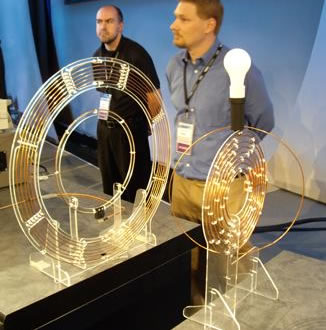
(Intel wireless demonstration - light bulb powered without wires)

Magnetic fields are used to broadcast up to sixty watts of power for short distances - two or three feet. Only 25% of the power is lost in transmission.

“Something like this technology could be embedded in tables and work surfaces,” said Justin Rattner, Intel’s chief technology officer, “so as soon as you put down an appropriately equipped device it would immediately begin drawing power.”

“In the future, your kitchen counters might do it,” Mr. Rattner said. “You’d just drop your espresso maker down on them and you would never have to plug it in.”

The project is being led by Joshua R. Smith, an Intel researcher in Seattle, Washington. Marin Soljacic, an MIT physicist, pioneered the original technique, called resonant magnetic fields. Read more about this technology in an earlier article - Wireless Power For Laptops, Cellphones?

The idea for wireless power transmission was first suggested by Nicola Tesla. Science fiction writers eagerly seized on the idea in the early twentieth century. In The Mightiest Machine, a novel serialized in Astounding Science-Fiction in 1934, the technology makes an appearance:

Aarn pushed a second standard into view, which was surmounted by a metal bowl that closely resembled a deep soup dish. The inner surface was evidently a parabolic one, made up of a maze of tiny coils, each oriented carefully toward some definite aim, while the entire rim of the "soup dish" was a single larger coil. Carefully Aarn adjusted it so that it pointed toward the flickering cage of copper wires, and beyond it to the apparatus at the other end of the bench. This apparatus seemed fairly simple, merely a number of standards with various arrangements of wires. Two parallel copper bars, a double spiral made of two insulated wires, two metal disks.

Intel powers netbook via thin air Wireless juice due 2015

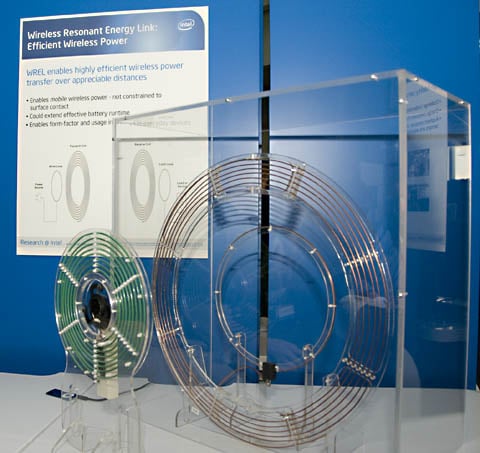
The demo setup included a hefty transmitter and receive-coil pair in which the receive coil had at its center a small speaker, with both the audio signal and the power required to drive the speaker being transmitted wirelessly.

The WREL, as its name implies, transmits power by setting up a resonant relationship between the transmitter and the receive coil, much as does the battery recharger in your wireless electric toothbrush.

However, as Intel researcher Emily Cooper told The Reg, the WREL's power transmission is "very different from the electric toothbrush charger [power] that falls off after about a millimeter."

Although the demo was transmitting only about one or two watts at a distance of over a meter, Cooper claimed that in Intel's Seattle lab, they've managed to power a netbook at distances of between one and two meters, providing between 14 and 20 watts. She also said that lab tests had powered 40 and 60-watt light bulbs.

Research@Intel: Wireless Resonant Energy Link demo

Intel's wireless-power prototype - transmitter on the right, speaker-equipped receive coil on the left

Cooper demonstrated that the receiver didn't drop or attenuate the signal when it changed its orientation in the transmitted beam. Even at a 90 degrees orientation to the transmitter, the receive coil's tinny speaker's tunes remained equally tinny. Her explanation: "As long as we're capturing some of the flux from this source, we can transduce that."

She also pointed out that the transmitted power is not subject to the familiar inverse square law, which decrees that signal strength is inversely proportional to the square of the distance from the transmitter. "That's what's interesting about this coupling mechanism," she said, "there are ways to make the transfer efficiency constant until you reach a certain point."

Intel Celebrating 40th Anniversary with World Mural Project

Intel Corporation celebrating its 40th Anniversary at 18th July and also unveils the World Mural Project publicly. It been a long journey of innovation and countless technology introduced by Intel Corporation. Intel has announced the World Mural Project on the day of the anniversary, which is a Web-based digital art piece that includes visual and written contents from the Intel Computer Clubhouses around the world. So many technologists have worked on this project all over the world and hundreds of Intel volunteers at 70 Clubhouses around the world helped the youth on the project.

Intel CEO and President Paul Otellini stated that “Intel has a 40-year history of serial technology breakthroughs and innovation. When we introduced the microprocessor no one could have predicted that the market for PCs would be greater than 350 million units a year. Over the next 40 years Intel technology will be at the heart of breakthroughs that solve the big problems of health and environment. For Intel this is just the beginning of its journey.

Intel Corporation is a world leader in silicon innovation; continue developing advance technologies and products for people and future of digital live. For more information on Intel Co. Visit Following website:

Chipmaker Intel Vs Advanced Micro Devices (AMD)

Recently Chipmaker Intel Corporation plays the game against Advance Micro Devices (AMD) and paid retailer not to sell PCs using chip made by AMD. This new accusation made by European Union Antitrust Regulators.

The ’statement of objections’ from the European Commission is an expansion of the 2007 charges that Intel gave computer makers rebates to limit their use of AMD chips or avoid them altogether.

According to this, commission is now weighing charges Intel unlawfully swindled with both the wholesale and retail channels in an effort to contain its rivals

Intel lawyer Steve Rodgers stated that “he was disappointed by the new charges, which centered on whether it was lawful or not to issue price discounts. The result will be higher computer prices because it prevents Intel from offering discounts

Intel was given eight weeks to respond to the charges. It would study them in detail before responding to the Commission in writing.

So it is very surprising that technology giant is following such kind of unethical marketing strategies. There must be a healthy competition in the marketing. I hope in future, we will not hear or read such kind of shameful things again.

Intel's MID UMPCs: So long XP/Vista, hello Linux


Big news on the UMPC front this morning folks. Looks like Intel is shedding the Origami gorilla (read: Microsoft) as they prep a Linux-based platform to compete with Vista and XP-based UMPCs. Intel will unveil their new MID (Mobile Internet Device) platform at the Intel Developer Forum in Beijing later this week. Unfortunately for their marketing department, they've already posted the slides. Unlike UMPCs which target mobile professionals, MIDs will target "consumers and prosumers" and feature a range of screen sizes from 4.5 to 6-inches with resolutions from 800 x 480 to 1024 x 600. Yup, these are the same devices we spotted under the in-house name of McCaslin sporting Intel's codenamed "Stealey" class of dual-core, battery-friendly processors. Intel's reference designs run a tweaked, 500MB version of China's RedFlag MIDINUX which boots in about 18 seconds (less than 5 seconds from standby) to a mix of open-source and proprietary code including Google Maps and web-based office and enterprise applications. Data access will be provided via HSDPA and WiFi. More GUI shots and reference designs in the gallery below.

Intel's AMD Antitrust Rebuttal: We're Not Bad, You're Just Stupid


Intel fired back at AMD in rebutting its antitrust lawsuit, saying the company has only itself to blame for not being competitive as a microprocessor supplier, with an inability to ship products on time, which helped to earn the company a bad reputation as a supplier with a poor track record of manufacturing investments:
Advanced Micro Devices Inc.'s failure to compete effectively with Intel in the microprocessor market is a "direct result of AMD's own actions or inaction," and weren't caused by any illegal actions by Intel, the microprocessor market leader said in court documents filed Thursday.
The filing in U.S. District Court was Intel's first formal response to AMD's lawsuit filed in June that charged Intel with using bribery and coercion of computer makers and retailers to limit the use of AMD processors.
AMD has used "out-of-context snippets ... to create the impression that Intel engaged in misconduct," Intel said its response. AMD's lawsuit also represents "a case study in legal dissonance. Although AMD has purportedly brought its complaint to promote competition, its true aim is the opposite. Under the cover of competitive law, AMD seeks to shield itself from competition."
Intel claims in its response that AMD is seeking to blame Intel for its own "many business failures ... that have determined its position in the marketplace." AMD's position in the marketplace "reflects its uneven track record, and its repeated failure to deliver on its promises."
Specifically, Intel points to AMD's "playing it safe ... with anemic investment in manufacturing capacity, leaving Intel to shoulder the burden of investment to enhance the usefulness of computers and enhance the market." In addition, Intel claims AMD has been "dogged" by a reputation of being unreliable as a supplier, has traditionally lagged in innovation, and has seen products delayed well beyond original launch dates.
When AMD has been able to deliver competitive products, such as with its Opteron server processors, it has seen share gains, Intel said.
AMD's allegations center primarily on the PC market, where chairman and CEO Hector Ruiz says the company has been unable to increase market share despite having highly competitive products in the past year. According to Mercury Research, AMD has seen its share of all x86 processors shipped, including those used in PCs and servers, rise from 15.1% in the second quarter of 2004 to 16.2% in the second quarter of 2005. When counting only x86 processors used in server applications, AMD has fared better, with its market share increasing 51% in the second quarter, from 7.4% to 11.2%
Intel argued that it hasn't violated any law or committed any wrongdoing. Intel said the AMD lawsuit is full of contradictions, including the claim that Intel's competitive actions could render it "nonviable." Ruiz has stated that the company "is in the strongest position we've ever been in."
Intel said it has demonstrated over a 30-year period that it can deliver faster, better, and cheaper products to consumers, in part because of its continued multibillion-dollar investment in new capacity and research and development even during downturns in the semiconductor market.
"In short," Intel wrote in its response, "AMD's colorful language and fanciful claims cannot obscure its goal of shielding the company from price competition."
Tom McCoy, executive of legal affairs and chief administrative officer for AMD, says Intel's response is "an attempt to divert attention from what this case is really about. Crossing swords of rhetoric is fun, but it's time to put the truth on the table in the courtroom. The industry problem is that [computer manufacturers and retailers] are under threats from retaliatory and potentially lethal price increases by Intel if they give too much business to AMD